Section 1/6Why we started by implementing Attio for ourselves
How we built our sales process in Attio in one working day
Before rolling out Attio for clients, we tested it on our own sales. Here is what we built, what it delivers and what we learned.
We recommend Attio to companies that want a CRM the team actually uses. We wanted to know first-hand what implementing it in a real sales process is like, so we started with our own.
Our starting point was a common one. Inquiries from the website arrived in a shared inbox, and follow-up happened there. There was no pipeline, no shared view of which companies we were talking to and nothing that said who should reply, or when.
On 16 October 2026 we went from an empty Attio workspace to live inquiries in one working day. This article covers what we built and what it delivers. It is not a technical manual.
Why we started by implementing Attio for ourselves
A CRM is often sold on features. What decides whether it gets used is something else: how quickly it is in place, and whether it removes work instead of adding it. We wanted to answer that from our own experience, not from a demo.
So we held ourselves to the same standard as a client project. The sales process and the data model were agreed before anything was built. No real customer data went in until the privacy policy was updated. And everything had to work without anyone needing to remember to check the inbox.
For a company thinking about switching to or introducing a CRM, that order is what makes the difference: process first, tool second.
What we built in Attio
We use only Attio's standard objects: companies, people and deals. There are no custom objects for anyone to maintain, and the structure is the one Attio is designed around.
The pipeline has seven stages and is built around how we work, with the systems and workflow review as a stage of its own: new inquiry, qualified, meeting booked, systems and workflow review, proposal sent, won and lost.
Around it are the automations that make the pipeline run itself:
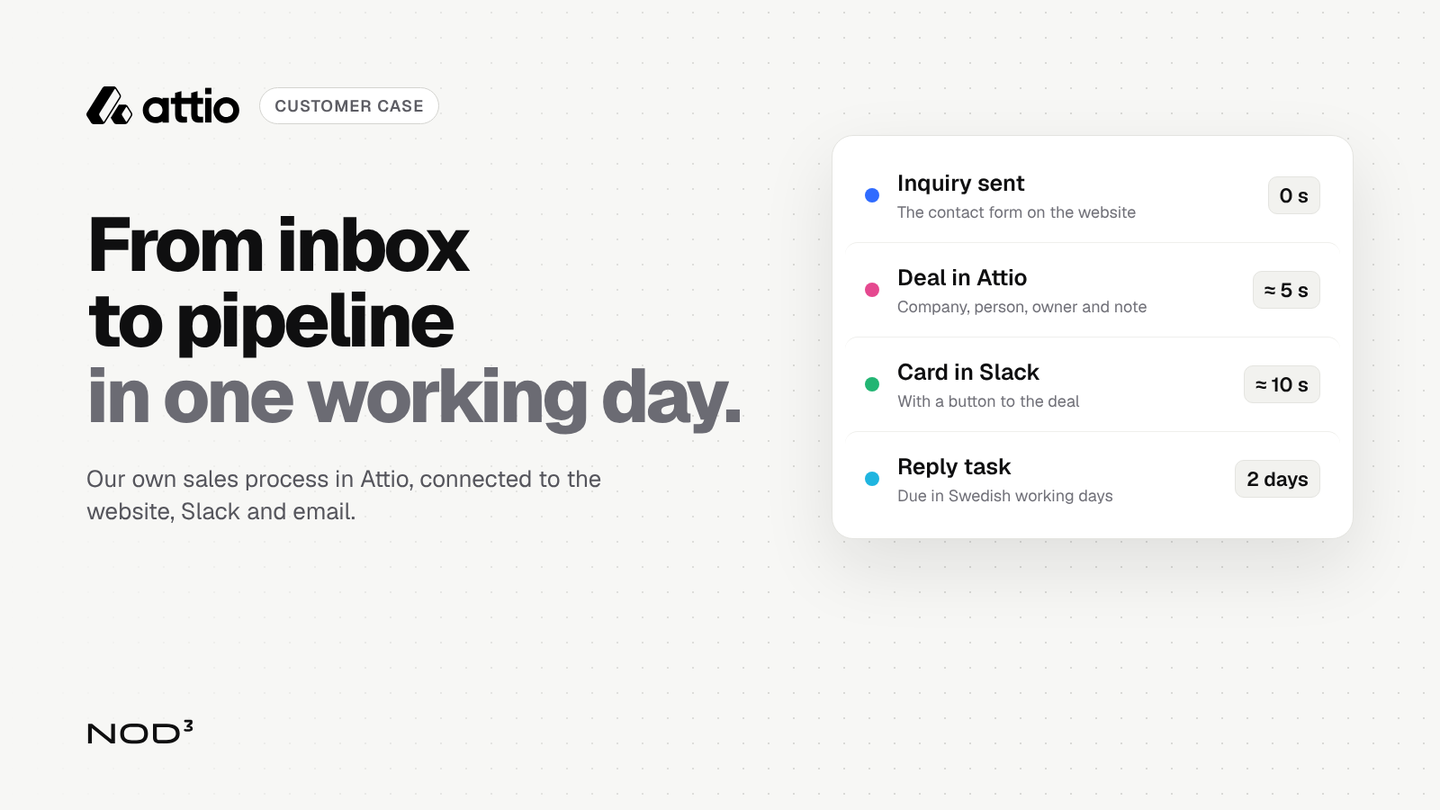
Every inquiry becomes a deal. The website form creates or matches the company and the person, opens a deal in the first stage with the message as a note and assigns an owner. When the same company gets in touch again, the inquiry is linked to the existing company record, so nothing we already know is lost.
Reply times in working days. Every new inquiry gets a reply task due within two Swedish working days, assigned to the deal owner.
The stages do the admin. Moving a deal to meeting booked creates a prep task for the next working day. Moving it to lost schedules a follow-up in six months, and moving it to won marks the company as a customer.
The pipeline comes to us. Every new inquiry becomes a card in Slack with a button to the deal. Every Monday a pipeline summary arrives in Slack and by email, and every weekday morning a short summary of the day's tasks.
Newsletter consent stays in sync. When someone subscribes or unsubscribes, their record in Attio is updated within seconds, so consent is always visible in the CRM.
Retention by policy. Every night, any data the privacy policy says we no longer keep is deleted.
The results in numbers
The figures were measured in our own build and in live tests through the website:
| What | Result |
|---|---|
| From empty workspace to live inquiries | 1 working day |
| Time for the build itself | about 5 hours |
| From form to deal in Attio | about 5 seconds |
| From form to card in Slack | about 10 seconds |
| From stage change to new task | about 2 seconds |
| Attio plan the core process needs | Free |
Attio's free plan covers up to three users according to Attio's pricing page (opens in a new tab) (October 2026), and nothing in the core process required a paid plan. During the trial we added one Pro feature on top: a rule that requires a reason when a deal is marked as lost.
What we cannot show yet is the effect on deals. We will measure that once there is volume. What is already clear is that no inquiry depends on someone happening to see an email, and that everyone sees the same pipeline.
We wanted a CRM we would be happy to recommend to our own clients, so we built our own sales on it first. Every inquiry now lands in Attio within seconds, with an owner and a deadline, and nothing depends on someone remembering to check the inbox.
Four things we take into client projects
Simple beats flexible. Attio can be extended in almost any direction. What gave us speed was sticking to what Attio is built for and only adding what helps sales.
Every tool has limits. We hit a few places where Attio did not do exactly what we wanted, including around deadlines and how data is updated. We solved all of them the same day, and we take that experience with us, so the next implementation will go even faster.
Update the privacy policy before real leads arrive. We confirmed with Attio that the data is stored within the EU and that the data processing agreement covers transfers, and added Attio to our privacy policy before the first real inquiry went in. That step is easy to forget once the tool is up and running.
Personal data does not belong in the chat. The Slack cards show company and reply time, but no names or contact details. Those live in the CRM, where permissions and retention apply.
Getting started with Attio: a clear path from inquiry to follow-up
We help you set up Attio around the way you manage customers and sales. Together, we agree what the first phase should cover. This can include:
A pipeline for the way you sell. Clear stages, relevant customer information and ownership of every deal.
Inquiries sent directly to your CRM. We connect the forms and systems included in the project so that inquiries are recorded with an owner and a next step.
Support for follow-up. Tasks, reminders and summaries based on the rules your team needs.
A clear plan for personal data. We review access, storage, retention and deletion rules, and the service providers involved before the solution goes live.
Training for your team. Views and a walkthrough that help people use the solution in their day-to-day work.
The scope and timeline depend on your sales process, the systems to be connected and the data to be migrated. Read more about our Integrations & automation service, and about what determines whether Attio is right for your business.
Frequently asked questions
Is Attio's free plan enough for a small sales team?
It was for us. The free plan covers up to three users according to Attio's pricing page (October 2026), and nothing in our core process needed more. More users or features such as stage rules require a paid plan.
How long does it take to implement Attio?
We built our own sales workflow in one working day. For your business, we develop a timeline based on your sales process, the amount of data involved and the integrations needed. We confirm the scope before work begins.
Can Attio be connected to the website, email and Slack?
Yes. For us, every form inquiry becomes a deal in Attio within about five seconds, new inquiries appear as cards in Slack and a pipeline summary arrives every Monday in Slack and by email.
How is GDPR handled when leads go into Attio?
We review which personal data will be processed, who needs access, how long the data should be kept and which service providers are involved. We then configure permissions and deletion rules, and update the information describing how the data is handled, to reflect the agreed solution.
How does NOD³ work on Attio implementations?
We start with your sales process and agree which customer information, deal stages and routines you need. We then set up Attio, connect the systems included in the project and train your team. Scope, timeline and responsibilities are agreed before work begins.
What would you like to improve?
Tell us about your situation and what you want to achieve. One of our founders will reply within two working days and help you identify a first step. The first conversation is free and there is no obligation to proceed.
What happens next?
- We review your inquiryWe read your inquiry and reply within two working days.
- We clarify the next stepWe ask follow-up questions or suggest a first conversation.
- You decide whether to proceedIf we can help, you receive a proposal for the next step with a defined scope and price.