Section 1/6E-invoicing requirements: in force, decided and under review
Why it pays to start e-invoicing before it becomes a requirement
A PDF by email is not an e-invoice. EU rules apply from 2030 and Sweden is looking into a domestic requirement. Companies that link the deal to the invoice benefit straight away.
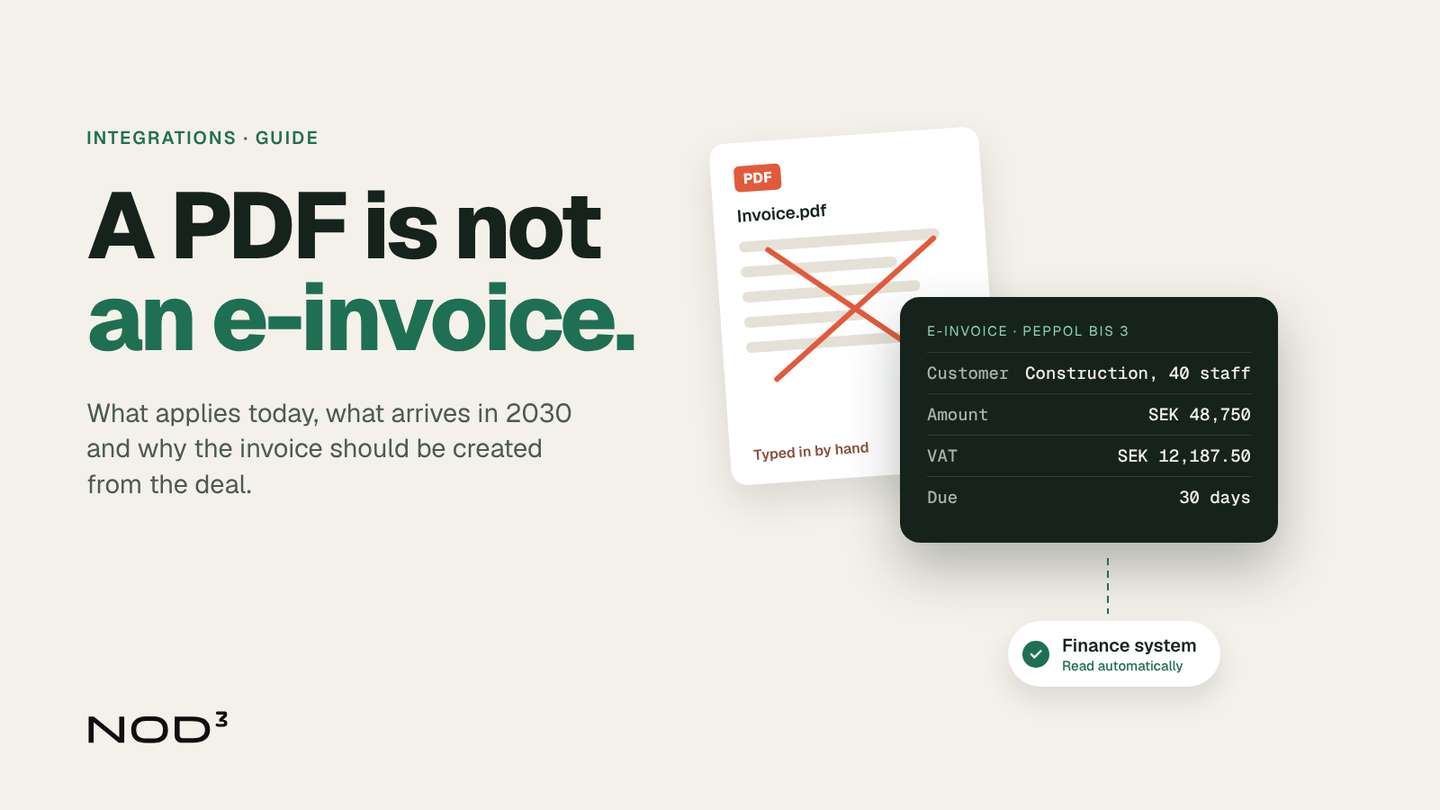
For many Swedish companies, an invoice means a PDF attached to an email. It looks digital, but it is not an e-invoice. In a survey from October 2026 by the Swedish Federation of Business Owners (opens in a new tab) (in Swedish), 84 percent of the members surveyed said they invoice with PDFs or other formats that do not count as e-invoices.
Meanwhile, the rules are changing. Under an EU directive, e-invoicing should become the standard, and the Swedish government is looking into whether e-invoicing should also be required for business within Sweden. This guide looks at the e-invoicing requirement in three stages: what already applies, what has been decided and what is under investigation. It also explains why companies that start now benefit before any requirement exists.
E-invoicing requirements: in force, decided and under review
| Invoices to | E-invoice required | Status |
|---|---|---|
| The public sector | Yes, after public procurement | In force since 1 April 2019 |
| Companies in other EU countries | Yes, with digital reporting | Decided, applies from 1 July 2030 |
| Swedish companies | Not today | Under investigation, proposals by 30 November 2027 |
The public sector. According to the National Agency for Public Procurement (opens in a new tab), companies that sell to municipalities, regions or government agencies under a procurement contract must send e-invoices if the procurement started on or after 1 April 2019. There are a few exceptions. A PDF invoice does not count as an e-invoice. The agency recommends the Peppol BIS Billing 3 format and the Peppol network.
Trade within the EU. The EU directive on VAT in the digital age (opens in a new tab), often called ViDA, says electronic invoicing should become the default way to issue invoices. The rules on e-invoicing and digital reporting for trade between companies in different EU countries apply from 1 July 2030. At the same time, each country may still allow other invoices for business within its borders. So the directive does not require e-invoicing between Swedish companies.
Within Sweden. The next answer will come from the government's inquiry into a modernised VAT system that helps prevent crime (opens in a new tab) (in Swedish). The inquiry will propose how the EU rules should be incorporated into Swedish law and assess whether e-invoicing and digital reporting should also be introduced for domestic transactions, that is, business within Sweden. It is due to report by 30 November 2027.
Why a PDF is not enough
A PDF is made to be read by a person, not by a system. Someone at the receiving company has to read it and type in, or interpret, the amounts, VAT, references and due date. An e-invoice is the same information as data in a defined format. The recipient's finance system can read it directly, match it to an order and suggest how to book it.
The recipient feels the difference most. That is why we believe the demand often comes from customers first: public sector customers today, and more and more larger companies that want to automate their own invoice processing. A small or mid-sized company selling to such customers will face the question long before any law requires it.
Opinion among business owners is divided. In the federation's survey (opens in a new tab) of just over 1,200 members, almost half were against a legal requirement for e-invoicing in business between Swedish companies, and just under a quarter were in favour. 43 percent use e-invoicing today, but six in ten of them do so in fewer than half of their transactions. Our view is that the question of a legal requirement matters less than what the company itself gains when the invoice becomes data.
The invoice is the last step in a process that starts with the deal.
The invoice is the end of a flow
In many small and mid-sized companies it looks like this: the deal closes in the CRM, someone emails finance, finance types the customer, items and price into the finance system, and the invoice goes out as a PDF. Every step where the same information is typed in again is a place where errors happen: the wrong price, the wrong reference, a forgotten invoice.
Swapping the PDF for an e-invoice only fixes the last step. The real gain comes when the whole chain is connected:
The deal in the CRM already has the customer, company number, products and price.
The order or contract is created from the deal instead of being retyped.
The invoice is created in the finance system from the order, and goes out as an e-invoice to those who can receive one.
The payment is reconciled automatically, and the status shows in the CRM so the salesperson sees who has paid.
That is the same kind of connection the e-invoice is built on: information that moves as data between systems instead of being typed in by hand. Our view: companies that build the chain now are ready when the requirements arrive, and stop doing the same work twice right away.
Five steps before the requirement arrives
Check your finance system. Can it send and receive e-invoices through Peppol, and what does it cost? The answer tells you whether you only need to change a setting or have to switch systems.
Map the flow from deal to payment. Note every place where someone types or copies information by hand. That is where the errors happen and the time goes.
Start with the customers already asking. Public sector customers already require e-invoices, and larger companies are often next. Switch them first.
Connect the CRM and the finance system. Let the invoice be created from the deal or order, so price, customer and reference live in one place.
Receive e-invoices too. Supplier invoices that arrive as data can be matched, approved and booked with less manual handling.
How we work
We start with the deal, not with the finance system:
Current state: we review the flow from deal to paid invoice and show where the time and the errors are.
The right connection: we connect the CRM and the finance system so the invoice is created from the deal, with customer, price and reference from one place.
Automation with control: the flows are built with error alerts, so an invoice that gets stuck shows up at once.
Step by step: first the customers that require e-invoices, then the rest.
Read more about how we work with integrations and automation.
Frequently asked questions
Is e-invoicing required for Swedish companies today?
Only for invoices to the public sector after a procurement that started on or after 1 April 2019, with a few exceptions. There is no requirement between Swedish companies today, but the government is investigating the question and is due to receive proposals by 30 November 2027.
Does a PDF count as an e-invoice?
No. An e-invoice is structured data in a defined format that the recipient's system can read automatically. A PDF invoice does not count as an e-invoice.
What is Peppol?
A network for sending e-invoices and other business documents between companies and public bodies. The National Agency for Public Procurement recommends Peppol and the Peppol BIS Billing 3 format for invoices to the public sector.
What changes in 2030?
From 1 July 2030, the EU rules on e-invoicing and digital reporting apply to trade between companies in different EU countries. The rules for business within Sweden have not yet been decided.
How does NOD³ help?
We review the flow from deal to invoice, connect the CRM and the finance system so the invoice is created from the deal, and automate the steps in between. How much work it takes depends on the systems in place today.
What would you like to improve?
Tell us about your situation and what you want to achieve. One of our founders will reply within two working days and help you identify a first step. The first conversation is free and there is no obligation to proceed.
What happens next?
- We review your inquiryWe read your inquiry and reply within two working days.
- We clarify the next stepWe ask follow-up questions or suggest a first conversation.
- You decide whether to proceedIf we can help, you receive a proposal for the next step with a defined scope and price.